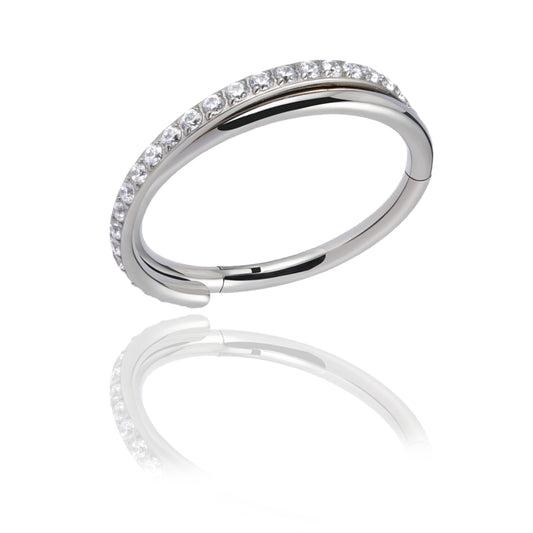
What is a quality piercing jewel?
A quality piercing jewel is a jewel that respects the body as much as it does style. It shouldn't just be pretty: it must be suitable for a pierced area, sometimes still fragile, and be able to be worn without causing unnecessary irritation.
A good piece of jewelry relies on several criteria:
- a reliable material that is clearly stated;
- a perfectly smooth surface;
- a size adapted to the placement;
- a comfortable closure system;
-
well-secured ends;
- a transparent product sheet;
- consistency between the jewelry, the area, and the healing stage.
It's this last point that is often forgotten. A piece of jewelry can be made of good material, but poorly suited to your piercing. For example, a ring that's too small for a helix, a bar that's too short for a nipple, or a heavily decorated piece on a fresh piercing can create more problems than anticipated.
Criteria to check before buying
1. The material must be precise
The first question to ask is simple: what is the jewel made of? A vague mention such as "surgical metal," "premium alloy," or "superior quality" is not enough.
For a reliable jewel, look for a clearly identified material, for example:
-
ASTM F-136 titanium;
-
ASTM F-67 titanium as appropriate;
-
ASTM F138 implant-grade steel;
-
14k or 18k solid gold, nickel and cadmium-free;
-
niobium;
-
suitable glass, for certain specific jewels.
At Naald, we prioritize ASTM F-136 titanium because it offers an excellent balance of tolerance, lightness, durability, and comfort.
2. The finish must be smooth and clean
A piercing jewel is in direct contact with the channel. A rough, scratched, poorly polished, or irregular surface can snag tissues, retain debris, and perpetuate irritation.
A good jewel must have a clean, smooth finish, without burrs, without rough spots, and without visible traces of poor manufacturing. This is particularly important for new or sensitive piercings.
3. The closure system really matters
Internal threading and threadless systems are often more comfortable, as the part that passes through the piercing remains smooth. Conversely, external threading can cause a threaded area to pass through the channel during insertion or changing.
However, it's important to be nuanced: internal threading is not the only sign of quality. Depending on the type of jewelry, the area, and mechanical constraints, other systems may exist. The true criterion is the consistency between the material, finish, strength, and use.
4. The size must match your piercing
Material is not enough. A jewel that is too short can compress the tissues. A jewel that is too long can move around, snag, cause friction, or perpetuate irritation.
Before buying, check:
- the thickness of the jewel;
- the bar length;
- the diameter of the ring;
- compatibility with your placement;
- the healing stage of your piercing.
5. Stones and ends must be securely fixed
A quality decorative jewel should not lose its stones after a few days. The setting must be clean, regular, and suitable for daily wear.
Stones that are simply glued or poorly secured are a point of vigilance: if a stone falls out, the jewel can become uncomfortable, snag more easily, or present a less clean surface.
To remember: a good piercing jewel is not just "titanium". It's a clear material, a good finish, an adapted size, a comfortable closure, and a product sheet transparent enough to buy without guessing.
Table: good signal or bad signal?
| Criterion |
Good signal |
Bad signal |
| Material |
ASTM F-136 titanium, suitable solid gold, niobium, clearly named material. |
"Metal", "alloy", "surgical quality" without precision. |
| Finish |
Smooth, polished surface, no scratches or visible rough spots. |
Rough, dull, poorly polished jewelry or with burrs. |
| Closure |
Internal threading, threadless, well-adjusted clicker depending on the jewel. |
Closure that moves, often unscrews, or has visible play. |
| Size |
Length, diameter, and thickness clearly indicated. |
No dimensions or vague sizes. |
| Decoration |
Well-set stones, clean ends, easy-to-clean surfaces. |
Glued stones, aggressive reliefs, decoration that snags. |
| Product sheet |
Material, color, size, closure system, and use indicated. |
Very little information, vague promises, no technical indications. |
Material: an important criterion, but not the only one
Material remains one of the most important criteria, especially for a new, sensitive, or irritation-prone piercing. However, this article does not replace a complete comparison between two specific metals.
If your main question is "should I choose titanium or surgical steel?", consult our dedicated article: titanium or surgical steel piercing.
Why ASTM F-136 titanium is a good quality benchmark
ASTM F-136 titanium is lightweight, stable, corrosion-resistant, and very well tolerated by most skin types. It's an excellent choice if you want to limit material-related doubts, especially for sensitive piercings or everyday jewelry.
It's also an interesting material for PVD-type gold finishes, provided that the base of the jewel is indeed quality titanium.
Beware of gold finishes and plated jewelry
A gold-colored jewel is not automatically a low-quality jewel. It all depends on the base and the finish.
-
PVD on titanium: an interesting option if the base is reliable.
-
14k or 18k solid gold: a premium option if the alloy is suitable for piercing.
-
Plated, vermeil, gold-filled: to be avoided on a new or sensitive piercing, as the surface layer can wear off.
Fashion materials: to be used with caution
Silver, brass, plated jewelry, unspecified alloys, or fashion jewelry may be suitable for certain decorative uses on a perfectly healed piercing, but they are not the best choice for a new, sensitive, or irritated piercing.
The problem is not just allergies: it's also oxidation, scratches, deposits, tarnishing, and long-term durability.
How to read a piercing product sheet?
A good product sheet should help you buy without guessing. If you have to search everywhere to understand the material, size, or closure, that's not a good sign.
Information that should be visible
-
Exact material: for example ASTM F-136 titanium.
-
Color: natural titanium, gold PVD, other finish.
-
Dimensions: thickness, length, diameter.
-
Jewel type: labret, ring, curved barbell, straight barbell, clicker, threadless.
-
Closure type: internal threading, clicker, segment, threadless.
-
Recommended areas: helix, tragus, conch, nose, navel, nipple, lobe, etc.
-
Usage advice: healed piercing, initial piercing, decorative jewel, maintenance.
Warning signs before purchase
- no precise material;
- no size indicated;
- very blurry or overly retouched photos;
- overly absolute promises;
- abnormally low price for a material advertised as premium;
- no information on closure or compatibility.
A higher price does not always guarantee quality. However, a clear product sheet, reliable material, precise sizes, and consistency between the jewel and its use are good indicators.
What jewel to choose to buy more confidently?
If you want a simple and reassuring choice, start with an ASTM F-136 titanium jewel, well-sized, with a clean finish and a closure system adapted to your piercing.
For ear, nose, navel, nipple, or lip piercings, this provides a reliable base before focusing on style: silver, gold, discreet, floral, minimalist, bold, or more elaborate.
Our general collection brings together Naald's ASTM F-136 titanium jewels to help you choose according to your placement and style: see all our piercing jewelry.
Want to choose a reliable jewel without analyzing every technical detail?
Explore our complete collection of ASTM F-136 titanium piercings: rings, labrets, curved barbells, straight barbells, ear, nose, navel, and nipple jewelry.
See all our piercing jewelry
To go further
FAQ: recognizing a quality piercing jewel
How to tell if a piercing jewel is of good quality?
Check the material, standard, finish, dimensions, closure system, and consistency with your piercing. A clear product sheet is often a good first sign.
Is ASTM F-136 titanium a good choice for a piercing?
Yes. ASTM F-136 titanium is lightweight, durable, very well tolerated, and particularly suitable for sensitive skin or everyday jewelry.
Is internal threading mandatory for a quality jewel?
It is often preferable, especially for a new or fragile piercing, because the part that passes through the channel remains smooth. But quality also depends on the material, finish, size, and adaptation to the area.
Is a cheap jewel necessarily of poor quality?
Not always, but a very low price with an advertised premium material should make you wary. The most important thing is transparency: exact material, dimensions, finish, and type of closure.
Can you wear silver or plated jewelry in a piercing?
It's best to avoid silver, plated, vermeil, or vague alloys on a new or sensitive piercing. These materials can oxidize, wear out, or expose a less well-tolerated base.
What should you look for first before buying piercing jewelry?
First, look at the material, then the size and compatibility with your placement. A beautiful piece of jewelry that is too short, too long, or ill-fitting can quickly become uncomfortable.
Conclusion
Recognizing quality piercing jewelry means learning to look beyond the photo. The material matters, but it's not enough: finish, size, closure, setting, and transparency of the product description are just as important.
If you're looking for a reliable base, ASTM F-136 titanium remains one of the best benchmarks for a more confident purchase, especially if your skin is sensitive or if you want comfortable everyday jewelry.
To move from verification to purchase, discover our collection of ASTM F-136 titanium piercing jewelry, designed to combine quality, comfort, and lasting aesthetics.
Sources