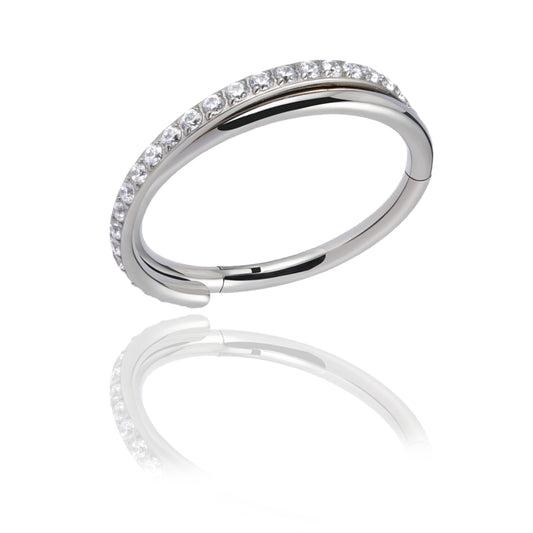
What jewelry to choose for accumulating piercings?
When multiple piercings are healing at the same time, the choice of jewelry becomes even more important. Ill-fitting jewelry can hinder the healing of one piercing, and also irritate neighboring areas.
For initial piercing: stability over style
During healing, it's best to prioritize stable, well-sized jewelry appropriate for the placement. Jewelry that is too heavy, too mobile, too tight, or overly ornate can snag, move, and maintain irritation.
For many ear piercings, a flat-back labret can be more comfortable during healing than overly mobile jewelry. Rings, chains, and dangling jewelry are often more suitable once the piercing is stabilized, depending on the area and the piercer's advice.
ASTM F-136 Titanium
ASTM F-136 titanium is an excellent choice for piercing jewelry: it's lightweight, well-tolerated, durable, and suitable for sensitive skin. This is particularly advantageous when wearing multiple pieces of jewelry at once.
At Naald, we offer ASTM F-136 titanium jewelry, available in natural titanium or PVD gold finishes depending on the models. To build your composition, you can browse all our ASTM F-136 titanium piercing jewelry.
Build your accumulation with reliable jewelry
Labrets, rings, clickers, helix, tragus, conch, daith or lobe jewelry: choose titanium pieces adapted to your composition.
View titanium ear jewelry
Healing multiple piercings: what changes
Getting multiple piercings at the same time requires more attention. Each piercing is a small wound that needs to heal. The more you have to manage, the more important aftercare, sleep, and daily habits become.
What can complicate healing
- sleeping on the pierced ear;
- wearing earbuds or headphones too soon;
- allowing hair to snag on jewelry;
- changing jewelry too quickly;
- touching piercings instinctively;
- cleaning too often or with harsh products;
- getting too many piercings on both ears at once;
- not getting a check-up or downsize when necessary.
If you have several recent piercings, maintain a simple and consistent routine. For detailed rules, consult our guide: piercing healing, rules to follow.
Should you get both ears pierced at the same time?
It's not always ideal. If you get multiple cartilage piercings on both ears, you risk not having a comfortable side to sleep on. This can cause pressure, swelling, irritation, and longer healing times.
In many cases, it's more comfortable to work on one ear at a time, then complete the other later.
Mistakes to avoid when wanting multiple piercings
Accumulating piercings is aesthetic, but it requires strategy. Here are the most common mistakes.
1. Wanting to do everything in one session
It's tempting, but rarely the best choice. A successful composition is often built in several stages. This allows for better healing, adjusting jewelry, and seeing how the ear evolves.
2. Copying a photo without considering your anatomy
An ear seen on Instagram or Pinterest can inspire, but it doesn't necessarily correspond to your morphology. The angle, cartilage fold, tissue thickness, and available space change everything.
3. Choosing definitive jewelry too soon
Initial jewelry should primarily support healing. Chains, decorative rings, pendants, or very elaborate compositions can come later, once the piercings are stabilized.
4. Neglecting snags
The more jewelry you have, the more you need to pay attention to your hair, clothes, towels, earphones, headphones, and pillows. If your piercing often snags, read our article: snagged piercing, risks and prevention.
5. Confusing accumulation with overload
A beautiful accumulation doesn't necessarily need ten piercings. Two or three well-placed pieces of jewelry can create a more elegant look than an overloaded ear. Balance counts as much as numbers.
When to slow down or seek advice?
If you have several recent piercings, pay attention to your body's signals. A little sensitivity can be normal, but certain signs should prompt you to slow down or seek advice.
- pain that increases instead of decreasing;
- significant or persistent swelling;
- spreading redness;
- significant local heat;
- yellow, green, or foul-smelling discharge;
- jewelry embedding;
- growing irritation bump;
- fatigue or fever associated with suspected infection.
When in doubt, contact your piercer. And if the signs suggest an infection, consult a healthcare professional. You can also read our article: infected or irritated piercing.
To go further
FAQ: getting multiple piercings
How many piercings can you get at once?
It depends on your body, the chosen areas, and your piercer's advice. For many projects, 2 to 3 piercings in one session is a more reasonable limit. Beyond that, healing can become more difficult to manage.
Can you get multiple ear piercings at once?
Yes, it is sometimes possible, especially if the placements are compatible. But it's best to avoid overloading the same ear or getting too many cartilage piercings in one session. The piercer must approve the project based on your anatomy.
Can you get two helix piercings at once?
It's possible in some cases, but cartilage requires long and stable healing. Two helix piercings on the same ear can be easier to protect than piercings spread across both sides, as you keep one ear free for sleeping.
How long should you wait between piercings?
There is no single timeframe. For a complete project, it is often better to wait until the first piercings are calm, stable, and easy to maintain before adding more. Your piercer can advise you based on your healing process.
Is it risky to get too many piercings at once?
Yes, it can increase discomfort, swelling, snags, difficulty with aftercare, and delayed healing. The more recent piercings you have, the more rigorous you need to be.
What jewelry should you choose for a piercing accumulation?
During healing, opt for stable, well-fitted jewelry made from a reliable material like ASTM F-136 titanium. More decorative jewelry, chains, or mobile rings are often more suitable once the piercings have stabilized.
Should you do one ear at a time?
It is often more comfortable. If you get too many piercings on both ears at the same time, you might have trouble sleeping without putting pressure on the healing areas.
How to create a beautiful accumulation without too many piercings?
Work on balance: a main piece of jewelry, a few finer pieces, consistent sizes, and suitable placements. A successful accumulation comes more from harmony than from the number of piercings.
Conclusion
Getting multiple piercings can create a very personal style, but it's not a race. A beautiful accumulation is built with a plan, a good piercer, appropriate jewelry, and respected healing.
If you're wondering how many piercings to get at once, remember this: it's better to proceed in stages than to overload your body. Two or three well-placed, well-cared-for, and well-chosen piercings can result in a more elegant outcome than an overly ambitious session.
To prepare your composition, discover our collection of titanium ear piercing jewelry, or explore all our ASTM F-136 titanium piercing jewelry.
Sources