Updated: March 28, 2026
Written by: Jean-Philippe
Reviewed by: Chloé, professional piercer
The meaning of an ear piercing is intriguing because it touches on something very personal: the image you project, the way you assert yourself, and what your choice can subtly convey. A helix, tragus, or conch piercing doesn't visually communicate exactly the same message. However, it's important to be nuanced: there is no universal or official code. The meaning of a piercing depends on the era, culture, style, overall ear composition... and most importantly, your own intention.
In this article, we will take a clear and more serious stance than many vague contents on the subject: yes, a piercing can suggest something. But no, it should not be read as an absolute truth. At Naald, we prefer to talk about contemporary symbolic interpretation: what each placement can evoke today in terms of style, personality, energy, or presence.
In 20 seconds
-
The meaning of a piercing is not fixed: it depends on the era, cultural references, and personal style.
-
Each placement can nevertheless suggest a different energy: discretion, boldness, creativity, structure, uniqueness…
-
The helix, tragus, conch, daith, or industrial piercing do not convey the same visual impression.
-
Right and left no longer have a universal meaning today: the choice has become primarily aesthetic.
-
An ear with 2, 3, or 4 holes often speaks more to a style intention than a "mystical" symbolism.
What is the meaning of an ear piercing today?
Historically, pierced ears could symbolize social status, belonging, a rite of passage, or a form of distinction. Today, in France and more broadly in contemporary fashion, the interpretation is different: an ear piercing primarily evokes a form of personal expression. It can suggest a more minimalist, assertive, sharp, creative, or sophisticated aesthetic depending on its placement and how it integrates with the rest of the ear.
In other words, the real question is not just "what does this piercing mean?", but also "what does it visually suggest today?". This is where the Naald approach becomes more interesting: instead of inventing arbitrary symbols, we observe what the placement actually conveys in a modern composition.
Our stance: a piercing doesn't automatically "reveal" your personality. However, it can highlight certain traits, reinforce an aesthetic, and give a clearer direction to your image.
The meaning of piercings by placement
Before going into detail, here is a simple interpretation of the main ear piercings. This table does not present fixed truths, but rather contemporary associations commonly found in current styles.
| Placement |
What it can suggest |
Dominant visual effect |
| Lobe |
softness, accessibility, simple elegance |
classic, easy to wear |
| Helix |
freedom, movement, creativity |
airy, modern, evolving |
| Tragus |
discretion, uniqueness, control |
subtle, precise, more intimate |
| Conch |
presence, balance, confidence |
central, structuring, visible |
| Daith |
introspection, intuition, uniqueness |
more secret, more intriguing |
| Rook |
character, independence, difference |
technical, uncommon, assertive |
| Flat / anti-helix |
attention to detail, composition, refinement |
graphic, clean, very stylized |
| Industrial |
boldness, energy, intensity |
strong, linear, very distinctive |
Helix: freedom, creativity and evolving style
The helix piercing is one of the placements most associated with freedom of style. Placed on the outer edge of the cartilage, it gives a sense of openness and movement. It is often chosen by people who like to be able to evolve their ear over time, add a ring, play with accumulations, or maintain a discreet but contemporary look.
Its meaning is not "spiritual" in the strict sense, but in modern interpretation, the helix often evokes creativity, independence, and an elegance without rigidity. It is one of the simplest piercings to integrate into a coherent composition. To go further, also consult our complete guide to helix piercing.
Tragus: discretion, uniqueness and control
The tragus piercing attracts those who like details that are not immediately noticed. It is often a more subtle, more internal, more personal choice. In a contemporary symbolic reading, the tragus can suggest a calm, attentive personality who does not need to do too much to assert their difference.
It often evokes mastery, restraint, and calm originality. It is a piercing that rarely says "look at me," but often ends up catching the eye precisely because it is not where it is expected. You can also consult our tragus piercing guide.
Conch: presence, balance and confidence
The conch piercing occupies a central area. Visually, it structures the ear and creates a strong anchor point. This is often what gives it a more confident interpretation. The conch is well suited for people who like clear, elegant piercings, but with a real presence.
In the current imagination, it can suggest an assertive personality, good taste, and a sense of aesthetic balance. It doesn't necessarily scream "rebel," but it's rarely mundane. You can also find our complete guide to conch piercing.
Daith: introspection, intuition and a more personal side
The daith piercing is regularly associated with a more personal or "inner" interpretation, especially because it is located in a less immediately visible area. It is often a piercing chosen for its uniqueness, its shape, or for the feeling of having a piece of jewelry that is more intimate than demonstrative.
Its modern symbolism can lean towards intuition, depth, and the search for a detail that matters more to oneself than to others. This also explains why it is often surrounded by more spiritual interpretations. For practical aspects, you can read our daith piercing guide.
Rook: character, difference and independence
The rook piercing is generally not the first choice for someone who wants something very classic. Its position and relative rarity give it a more independent image. It can suggest a personality that appreciates less obvious options, less expected choices, more connoisseur style markers.
In this logic, the rook often reflects a form of independence, character, and uniqueness. It attracts those who want to stand out without necessarily going overboard.
Flat and anti-helix: precision, attention to detail and composition
The flat and anti-helix / forward helix have one thing in common: they give the ear a more structured look. These are particularly interesting piercings in terms of composition. They often suggest a true sense of detail, a desire for balance, and a more conscious relationship to overall aesthetics.
This type of placement can evoke refinement, precision, modernity, and attention to visual coherence. It's not just a piece of jewelry placed on the ear; it's often an element conceived as part of a whole.
Industrial: intensity, boldness and strong structure
The industrial piercing is probably one of the most symbolically legible. It creates a strong line, immediate visual tension, and gives the ear a very distinct identity. It often attracts people who want a piercing with real presence and a more defined aesthetic.
It can suggest energy, boldness, strength of character, and a taste for clean lines. It's not necessarily an "aggressive" piercing, but it's clearly a more assertive choice than a simple lobe or a small flat. For the practical part, consult our industrial piercing guide.
Right or left: does it still have a meaning?
The question often comes up: does a pierced ear on the right or left still mean something? The most honest expert answer is: not in a universal way today.
Yes, certain eras have assigned more precise codes to the right or left, especially for men. Yes, some subcultures may have used pierced ears as a discreet sign of belonging. But in current usage, these codes are largely weakened. Today, the choice of right, left, or both ears is primarily a matter of style, morphology, habits, and aesthetic project.
Short answer: if you're looking for a simple truth about the "meaning of the right or left ear," it's best to consider that this code is no longer reliable today. What matters now is mostly what you want to express.
2, 3 or 4 ear piercings: what does a multiple composition suggest?
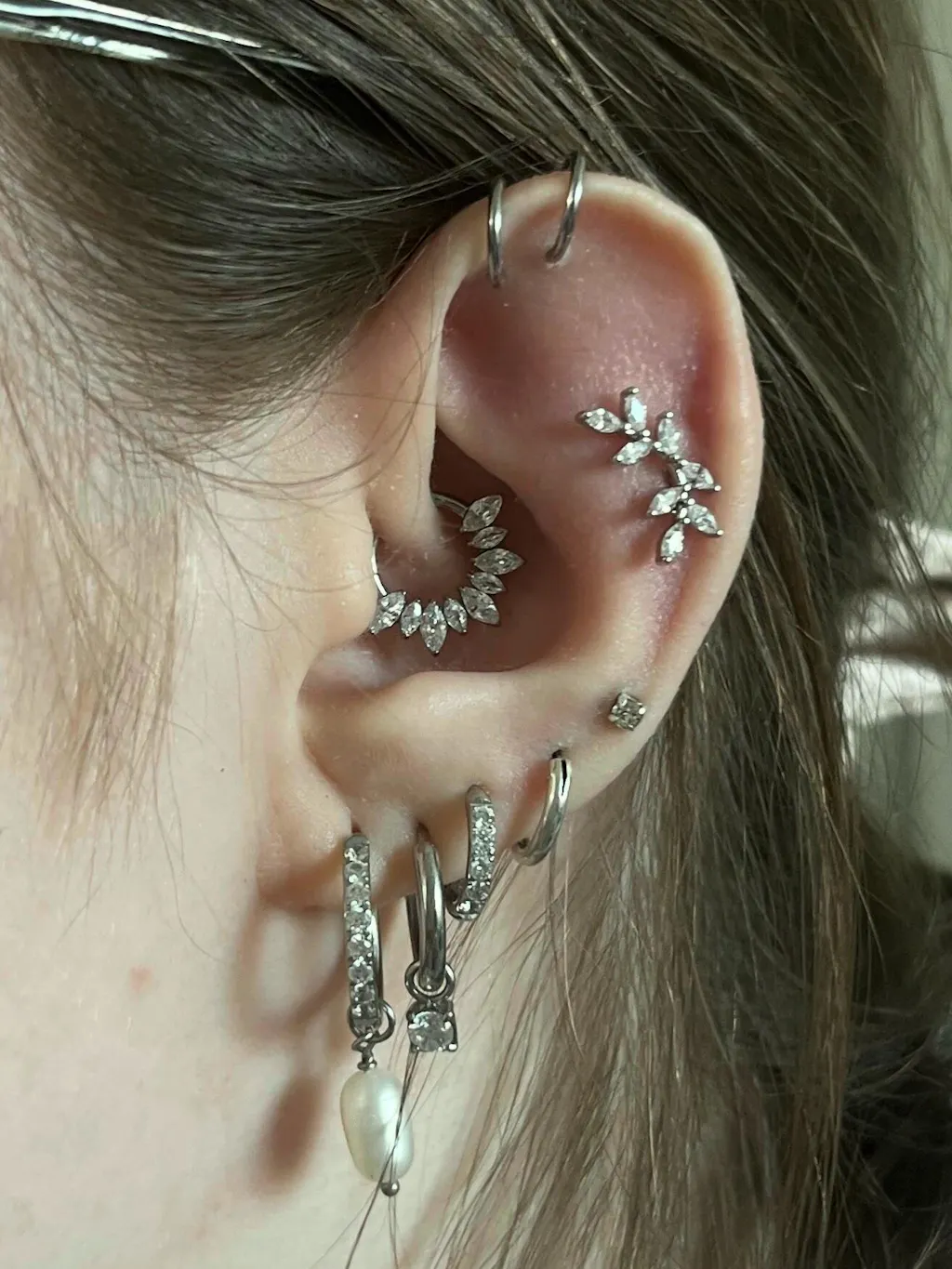
When we talk about 2, 3 or 4 ear piercings, the meaning is no longer just about an isolated placement. It comes from the composition. An ear with multiple piercings is often interpreted as a more elaborate, conscious, and assertive choice in how one constructs their style.
In practice, a multiple composition can suggest several things:
-
2 piercings: a desire to refine a classic, with something more structured than a single lobe;
-
3 piercings: an ear already conceived as a whole, often with a sense of rhythm or gradation;
-
4 or more piercings: a genuine stylistic approach, sometimes minimalist, sometimes bold, but rarely left to chance.
In other words, the more composed the ear, the more it often reflects an assumed relationship with detail, aesthetics, and visual identity. This is precisely what explains the success of the curated ear: one no longer simply chooses a piercing, but rather a way of constructing an ear silhouette.
If you are in this approach, you can also explore our selection of titanium ear piercings, designed to create coherent, elegant and durable compositions.
The spiritual meaning of ear piercings: what can be said seriously
The query "ear piercing spiritual meaning" is highly searched, but it deserves to be treated with caution. Yes, in different cultures and at different times, pierced ears have been linked to notions of protection, passage, belonging, or spirituality. But this should not be transformed into an absolute truth or a universal promise.
Today, when a person seeks a spiritual meaning for their piercing, they are often primarily looking for one of these three things:
- a symbolic gesture marking a life stage;
- a personal reminder linked to an intention, strength, or evolution;
- a way to add depth to an aesthetic choice.
In this context, the daith, tragus, or helix are sometimes endowed with a more internal interpretation. But the most accurate approach remains this: the spiritual dimension of a piercing is personal before it is collective. It can exist, but it cannot be decreed from the outside.
At Naald, we therefore advise you to think of the spiritual meaning of a piercing as an intention you give it, and not as a universal label attached to a specific area.
How to choose a piercing that truly reflects you?
If you're looking for a piercing that suits you, here's the most reliable method:
-
Start with your desired level of discretion: lobe and tragus for something more subtle, conch or industrial for a stronger presence.
-
Think about the overall ear aesthetic: do you want a focal point or a balanced composition?
-
Choose a visual energy: minimalist, graphic, soft, bold, structured, unique…
-
Consider your anatomy: not all ears allow for all projects in the same way.
The most beautiful piercing is not the one that "means" the most on paper. It's the one that looks right on you, on your ear, on your style, and on the story you want to tell.
To deepen your project, we also recommend:
FAQ: Meaning of ear piercings
What is the meaning of a helix piercing?
The helix piercing is often associated with freedom, creativity, and a form of modern elegance. It is particularly well suited for people who like to evolve their style over time.
Does the tragus have a special meaning?
Yes, in a contemporary interpretation, the tragus often evokes discretion, uniqueness, and a form of control. It is a subtle piercing, but rarely visually insignificant.
Does a pierced ear on the right or left still mean something?
Not really in a universal way. Some old codes existed, but today, right, left, or both are primarily a matter of aesthetic and personal choice.
What is the spiritual meaning of an ear piercing?
It is not universal. Some cultures have associated pierced ears with rites of passage, protection, or belonging. Today, the spiritual dimension of a piercing is mainly a personal intention.
What can 3 ear holes suggest?
Three ear holes often suggest a more considered, more stylish composition, and a strong taste for details. It's less a "code" than a way to build a visual identity.
In summary
The meaning of ear piercings is not limited to a fixed dictionary. Each placement can suggest something different, but it is above all the combination of placement, jewelry, composition, and your intention that creates a true meaning. This is precisely where piercing becomes interesting: not as an imposed symbol, but as a way to express something about yourself accurately.
Sources