New piercing at work: how to protect it?
A new piercing requires more caution, especially if your job involves tight clothing, a mask, a helmet, gloves, physical contact, dust, sweat, or repetitive movements.
Good habits
- do not remove the jewelry without professional advice;
- avoid touching the piercing during the day;
- wash your hands before any contact;
- avoid clothes or equipment that rub directly against it;
- monitor for unusual redness, pain, swelling, or discharge;
- clean according to your piercer's instructions, without overdoing it;
- have the jewelry checked if the size seems unsuitable.
For detailed care, consult our guide: piercing healing, rules to follow.
Can a new piercing be hidden with a bandage?
A bandage can sometimes be used temporarily to protect an area from rubbing or to comply with a temporary instruction. But it should not become a permanent solution, especially for a new piercing.
A bandage can retain moisture, irritate the skin, or pull on the jewelry when removed. If your job requires you to hide or protect a fresh piercing, ask your piercer for advice to find the least irritating solution.
Should you remove your piercing at work?
If your piercing is old and perfectly healed, temporary removal can sometimes be a solution. But not all piercings react the same way: some channels tighten quickly, even after several months.
If your piercing is new, removal is much riskier. The hole can close quickly, and putting the jewelry back in can irritate or injure the channel.
What about retainers or transparent jewelry?
Retainers can be useful in certain professional situations, but they must be chosen with caution. They are not always suitable for a new piercing, an irritated area, or a job where hygiene is very strict.
Before replacing your jewelry with a retainer, ask a piercer for advice. The material, size, shape, and wearing duration must be appropriate.
How to discuss your piercings with your employer?
If the topic becomes sensitive, maintain a professional approach. The goal is not to create a power struggle, but to understand the rule and propose a solution compatible with your job.
You can say, for example:
- "Can you explain the exact rule regarding piercings?"
- "Is this a matter of hygiene, safety, or professional image?"
- "Can I wear more discreet jewelry during my working hours?"
- "My piercing is new, I can't remove it without risk. Can we find a temporary solution?"
- “Does the rule apply to all visible jewelry or only to certain piercings?”
If you find the request unjustified or applied differently to various individuals, it may be helpful to ask for a written record or to inquire with human resources, occupational health, or legal counsel appropriate for your situation.
Further Reading
FAQ: Piercings at Work
Can my employer ask me to remove my piercing?
Yes, in some cases, but the request must be justified by your position: hygiene, safety, professional image, customer contact, or risk of snagging. A general prohibition without a concrete reason can be debatable.
Can piercings be prohibited in restaurants?
Yes, restaurants and the food industry are among the strictest sectors. Rules may aim to prevent risks of contamination, jewelry falling, or non-compliance with hygiene guidelines.
Can one wear a piercing in a hospital or in healthcare?
It depends on the position, department, and internal protocol. Hygiene rules may require the removal of certain jewelry, especially if it is visible, exposed, or in contact with equipment.
What if my piercing is new and I cannot remove it?
Calmly explain that removal can close the channel or irritate the area. Ask if a more discreet piece of jewelry, temporary protection, or a provisional adaptation is possible, then seek your piercer's advice.
Which piercing is the most discreet for work?
Ear piercings with small labrets, fine balls, or small zircons are often easier to wear. A septum piercing can sometimes be discreet depending on the jewelry, but everything depends on the position and internal regulations.
What jewelry should I choose to remain professional?
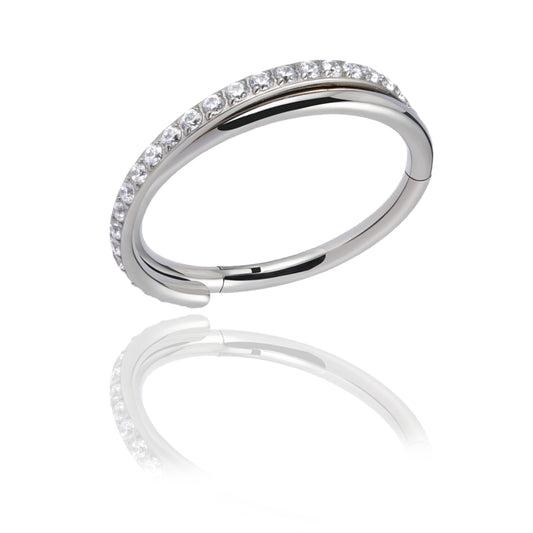
Opt for simple, well-fitted, low-shine jewelry, without chains or pendants. ASTM F-136 titanium is a good choice for comfortable, lightweight, and well-tolerated jewelry.
Can a piercing be a form of discrimination at work?
An employer should not disadvantage you solely based on your appearance. However, they can set rules if they are justified by your position and proportionate. If in doubt, ask for a written explanation or appropriate advice.
Conclusion
Wearing a piercing at work is often possible, but it depends on the position, sector, and internal rules. The most important thing is to distinguish between a personal preference and a genuine professional reason: hygiene, safety, image, customer contact, or risk of snagging.
If your employer asks you to remove your piercing, ask for the exact reason, check written rules, and propose a compromise. A more discreet, better-fitting, or temporarily replaced piece of jewelry may sometimes suffice.
And if your piercing is new, do not remove it without professional advice. It is better to anticipate, communicate, and choose appropriate jewelry. For a healed piercing or after your piercer's approval, discover our collection of ASTM F-136 titanium piercing jewelry, designed to combine comfort, quality, and style for everyday wear.
Note: This article is for informational purposes only and does not replace legal advice. Rules may vary depending on your contract, collective agreement, internal regulations, position, and sector of activity.
Sources