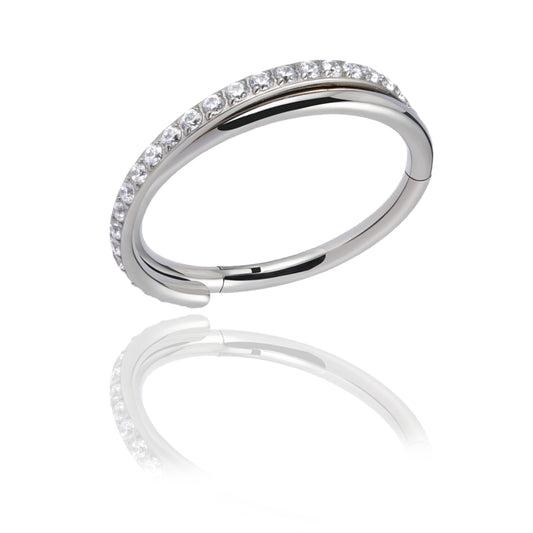
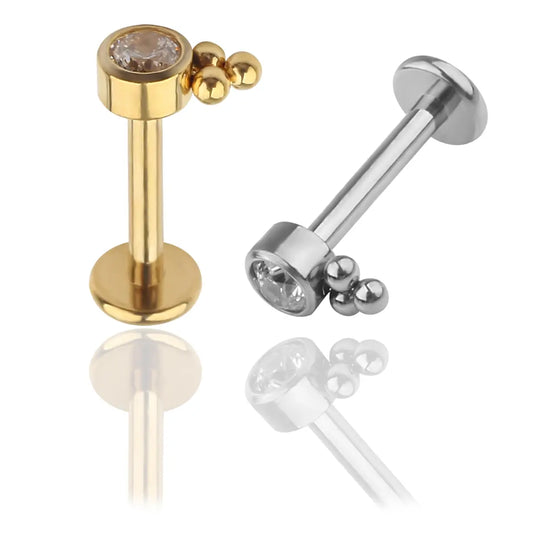
What is a conch piercing?
The conch piercing is located in the central part of the ear cartilage, which resembles the shape of a conch shell.

That's a conch shell.
There are different types of conch piercings, such as the inner conch piercing and the outer conch piercing. It is done with a labret-style bar.
If you want to know the symbolism and meaning of different ear piercings, you can read our article on the meaning of ear piercings.
Types of conch piercings
Inner conch piercing
The inner conch piercing is located in the middle of the ear cartilage, closer to the daith (the fold of cartilage above the ear canal entrance). This type of piercing is usually done with a bar and may take longer to heal due to its location.
|
|
This placement is extremely rare; the "classic" conch will be the outer conch. |
Outer conch piercing
The outer conch piercing is the most common type of conch piercing. It is done on the outer edge of the ear cartilage, and can be performed in different places, such as the upper conch and the lower conch. This type of piercing allows for more jewelry possibilities, such as rings, and generally heals faster than the inner conch piercing.

@STUDS / INSTAGRAM / BYRDIE
 |
This is the most common conch, it is more comfortable, heals faster, and offers more customization options in terms of jewelry. |
Double conch piercing
A double conch piercing consists of two conch piercings placed one above the other or horizontally. This creates an interesting layered effect and offers even more styling options.

Credits : ASSOLARI
To learn more about another cartilage piercing often associated with the conch, you can consult our complete daith piercing guide .
Orbital conch piercing
The orbital conch piercing is a rarer piercing that requires two holes. One hole is made in the outer conch and another in the outer cartilage of the ear (where helix piercings are usually made). A ring is then inserted into both holes, creating the effect that the jewelry orbits around the ear cartilage.

Josh Allgood / TWITTER
|
This piercing is extremely rare. Few piercers perform it and it requires a very specific morphology. Moreover, it is particularly painful and difficult to heal. |
More inspiration and information on all ear piercings with our dedicated guide.
Does a Conch Piercing hurt?
In short: the pain of a conch piercing is moderate for a cartilage piercing, and the discomfort lasts only a few days.
A conch piercing goes through a fairly dense area of cartilage, which is why it is often perceived as more sensitive than a helix or a lobe, but less intense than a daith. The pain is generally brief: a marked pressure, followed by a rapid peak that immediately subsides. Many people compare this sensation to a strong but very short pinch.
The level of discomfort primarily depends on your anatomy and the technique used. When the cartilage is thick or the area is a bit hollow, the piercer may need to adjust the needle's trajectory with precision, which slightly intensifies the sensation. Once the piercing is done, local warmth, tension, or a pulse in the ear are normal reactions during the first few days.
A clean piercing, performed in a single motion, combined with a well-sized ASTM F-136 titanium jewel, clearly reduces pain and allows the area to stabilize more quickly. Generally, most clients describe the conch piercing as an intense but very manageable moment, lasting only a few seconds.
Conch piercing healing time
Conch piercing healing is generally longer than that of a lobe, and averages between 3 and 9 months depending on the care provided. The healing time of a conch piercing depends on various factors, such as the piercing method used, aftercare, and the person's overall health. It is important to follow the post-piercing care instructions given by your piercer to promote quick and complication-free healing.
What care for a conch piercing
Aftercare for a conch piercing is essential to promote proper healing and prevent any issues you might encounter. Here are some tips for taking care of your conch piercing:
- Gently clean your piercing with a sterile saline solution twice a day. Avoid using soap or irritating products.
- Avoid touching or handling your piercing with dirty hands.
- Avoid sleeping on the side of the piercing during the healing period.
- Avoid wearing headphones or earphones during the healing period.
- Avoid changing your jewelry before the piercing is completely healed.
- Consult a professional if you notice signs of infection, such as redness, pain, swelling, or abnormal discharge.
Downsizing: when and why to adjust the jewelry size
Downsizing (or “size reduction”) consists of replacing the initial jewelry with a more suitable one once the conch has deflated. This is a common step, especially when the initial piercing was done with a slightly longer labret to allow for swelling.
Why downsizing is important?
-
Comfort: jewelry that is too long moves more, snags more easily, and can become bothersome.
-
Better healing: less movement = less irritation and "bumps" due to friction.
-
Aesthetics: the jewelry sits better, more neatly, especially on cartilage.
When to downsize?
There's no universal date: it depends on your anatomy, initial inflammation, and lifestyle. In practice, downsizing is considered when the swelling has gone down and the jewelry has too much "play". This can happen after a few weeks, but sometimes later if the piercing has been irritated or if healing is slower.
Signs that your jewelry has become too long
- The bar protrudes significantly (you see "too much length" permanently).
- The jewelry moves a lot when you sleep, do your hair, or wear headphones/earbuds.
- You often snag the jewelry (hair, towel, mask, clothing).
- You have recurrent irritations even though you're caring for it correctly.
How to downsize safely?
-
Safest option: have it done at a studio, with sterile equipment and appropriate jewelry.
-
Avoid "at-home" changes if the piercing isn't stable: risk of irritation, micro-lesions, and infection.
- If you do change it yourself: clean hands, clean environment, quality jewelry (ideally ASTM F-136 titanium), and most importantly, never force it.
Downsizing and switching to a ring: not the same thing
Downsizing often concerns the bar length (labret) to gain stability during healing. Switching to a ring, on the other hand, is generally done when the piercing is well stabilized: a ring can put more stress on the cartilage if inserted too early.
To remember: if your jewelry "catches" and moves a lot once the swelling has subsided, it's often a good time to consider downsizing. When in doubt, visiting a studio remains the simplest and safest solution.
Irritations and common problems with a Conch piercing
Like all cartilage piercings, the conch can react to certain daily friction or movements. Irritations are generally benign, but they can slow down healing if the area is overstimulated.
The most frequent causes of irritation are:
- pressure exerted by sleeping on the piercing
- headphones pressing directly on the area
- hair, hats, or scarves pulling on the jewelry
- jewelry change performed too early
- jewelry that is too long or too short, creating permanent micro-movement.
Slight redness, tenderness to the touch, or temporary swelling are common reactions during healing. They usually disappear within a few days when the area is left undisturbed and cleaned according to your piercer's recommendations.
If the irritation persists, worsens, or if you have any doubts, it is advisable to go back to your piercer for their opinion. In most cases, a few simple adjustments (change of length, repositioning of the jewelry, or care advice) are enough for the situation to improve.