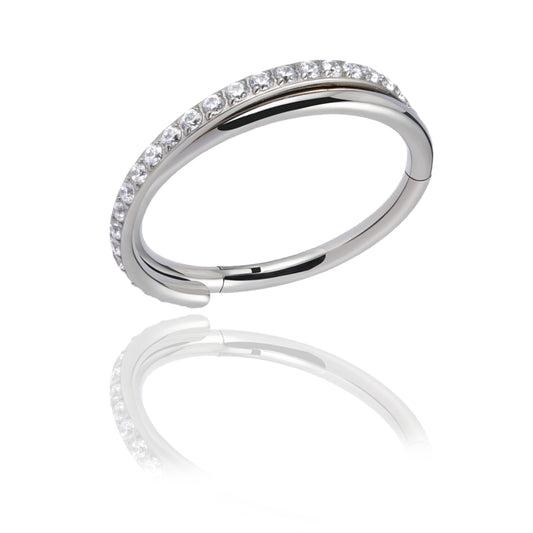
What is gold PVD?
PVD stands for Physical Vapor Deposition. It is a process that allows a thin layer of finish to be deposited on the surface of jewelry in a controlled environment.
In the case of gold PVD piercing jewelry, the goal is to achieve a golden finish, visually similar to yellow gold, while retaining the advantages of a base more suitable for piercing, such as titanium.
The essential point is this: gold PVD is a finish. It does not replace the main material of the jewelry. If the base is of poor quality, the gold finish is not enough to make the jewelry reliable.
To remember: before buying a gold PVD piercing, always check the base material. The mention "gold" or "golden" is not enough. Look for a clear indication like ASTM F-136 titanium.
Gold PVD, gold plated, or solid gold: what are the differences?
Not all gold jewelry is created equal. For a piercing, the difference is important, because the jewelry remains in direct contact with the skin, sometimes in an area that is still sensitive.
| Type of gold jewelry |
What it is |
Advantage |
Point of caution |
| Gold PVD on titanium |
Gold finish deposited on a titanium base. |
Good compromise between golden finish, lightness, and comfort. |
Prefer on a clearly indicated base, ideally ASTM F-136 titanium. |
| Solid gold 14k or 18k |
Jewelry made of solid gold alloy. |
Very durable if the alloy is suitable for piercing. |
More expensive. Gold that is too pure, like 24k, is too soft for many body jewelry pieces. |
| Gold plated |
Thin layer of gold applied over another metal. |
Often attractive price. |
The layer can wear off and expose the base material. Avoid for new or sensitive piercings. |
| Vermeil / gold filled |
Techniques of covering or assembling around gold. |
May be suitable for certain classic jewelry. |
Not ideal for a new or fragile piercing. |
For a piercing, gold PVD is therefore particularly interesting when applied to a quality base. Gold PVD on ASTM F-136 titanium is much more reassuring than a gold finish whose base is not clearly indicated.
Is gold PVD safe for a piercing?
The answer depends on the context. Gold PVD can be an interesting finish, but it should not be presented as automatically suitable for all situations.
For a new piercing
For a fresh or healing piercing, the priority remains biocompatibility, finish, size, and stability of the jewelry. Many professionals prefer a simple and proven base, such as uncoated implantable titanium, especially for the first few weeks or sensitive areas.
If you want to wear a gold finish from the start, don't decide alone: ask your piercer for advice. They can evaluate the area, the jewelry, the quality of the finish, and the healing status.
For a healed piercing
For a healed piercing, gold PVD on titanium becomes a very interesting option if you want gold jewelry that is more accessible than solid gold, with good daily resistance.
It is often the best compromise for those who want to harmonize several gold jewelry pieces on the ear, nose, navel, or other piercings, without immediately investing in solid gold.
For sensitive skin
If you have sensitive skin, the most important thing is to check the base of the jewelry. Gold PVD on ASTM F-136 titanium is generally much more reassuring than gold jewelry with a vague composition.
However, if your skin reacts easily, or if your piercing is still unstable, the safest choice is to seek advice from a professional before making a change.
Advantages of gold PVD for piercing jewelry
A golden finish more accessible than solid gold
Gold PVD allows you to achieve an elegant gold color without the price of solid gold jewelry. This is particularly interesting if you like to change your style, create an accumulation of gold jewelry, or harmonize several piercings.
Better durability than simple gold plating
PVD is generally more resistant than classic plating. It holds up better to daily friction, even though it remains a surface finish and not an indestructible material.
A good option on a titanium base
On an ASTM F-136 titanium base, gold PVD combines a lightweight and well-tolerated material with a golden aesthetic. This is precisely what makes this finish interesting for piercing jewelry.
A finish suitable for everyday style
Gold PVD is easily worn: helix, tragus, conch, lobe, nose, navel, nipple, rook, daith... It provides a warmer look than natural titanium, without resorting to costume jewelry with an uncertain composition.
Limitations and precautions to know
Gold PVD is a good option, but it should not be presented as magical. Like any finish, it can wear out over time, especially in areas highly exposed to friction.
The main limitations to know:
- the finish may wear out faster if the jewelry experiences a lot of friction;
- chemicals, perfumes, chlorine, cosmetics, and aggressive cleaners can alter the appearance;
- poor quality PVD jewelry may age poorly;
- if the base of the jewelry is unclear, the gold finish guarantees nothing;
- for a new piercing, always confirm with a professional.
The trap to avoid: buying jewelry simply because it says "gold," "golden," or "PVD." The true quality criterion is the combination: reliable base + clean finish + adapted size + consistent use.
How to choose good gold PVD piercing jewelry?
Before buying gold PVD jewelry, check several points. This will prevent you from choosing jewelry based solely on its color.
1. Check the base material
The product sheet should clearly indicate the material: ASTM F-136 titanium, ASTM F-67 titanium, ASTM F138 implant-grade steel, solid gold, etc. For Naald, the best reference remains ASTM F-136 titanium.
2. Check the compatible area
A piece of jewelry can be very beautiful, but not suitable for your location. A helix ring may not be suitable for a conch. A labret may be suitable for several areas, but the length and thickness must be appropriate.
3. Check the size
Diameter, length, thickness: these dimensions matter. Jewelry that is too tight can compress tissues. Jewelry that is too long can move, snag, and irritate.
4. Check the finish
Good jewelry should be smooth, well-polished, and free of rough spots. This is even more important with a colored finish, as repeated friction can alter the surface in the long term.
5. Check the closure system
Internal threading, threadless, clicker, segment: the system must be adapted to the area and comfortable. For sensitive piercings, avoid jewelry that snags or requires too much manipulation.
To start with a reliable base, you can consult our complete selection of ASTM F-136 titanium piercing jewelry, available in natural titanium or gold PVD finish depending on the models.
Want a gold piece of jewelry without choosing at random?
Discover our ASTM F-136 titanium piercing jewelry, with silver or gold PVD finishes depending on the models.
View all our piercing jewelry
How to care for gold PVD jewelry?
Well-maintained gold PVD jewelry can retain its shine for a long time. But since it is a finish, it is important to avoid actions that promote wear.
Good habits
- Clean gently with a mild, piercing-safe solution.
- Rinse and dry after heavy perspiration or prolonged water exposure.
- Avoid repeated friction with clothing, helmets, towels, or hair.
- Store the jewelry separately if not wearing it.
- Handle with clean hands.
What to avoid
- perfume, hairspray, hair products, or cosmetics directly on the jewelry;
- chlorine, prolonged salt water, or household cleaning products;
- abrasive cleaners or aggressive wipes;
- scrubbing with a hard brush;
- forcing the jewelry during insertion or removal.
If the finish begins to wear, tarnish, or show irregular areas, it is best to avoid continuing to wear the jewelry on a sensitive piercing.
To learn more
FAQ: Gold PVD piercing
Is gold PVD real gold?
No, gold PVD is not solid gold jewelry. It is a gold finish applied to a base material, for example, titanium. The appearance is golden, but the main structure of the jewelry depends on the material indicated on the product sheet.
Is gold PVD better than gold plated for a piercing?
Yes, in most cases, gold PVD is more durable than classic gold plating. But the quality always depends on the base of the jewelry. Gold PVD on ASTM F-136 titanium is more advantageous than a gold finish on an unknown material.
Can gold PVD be worn on a new piercing?
It is best to ask your piercer for advice. For a fresh piercing, many professionals prefer a simple base like uncoated implantable titanium. Gold PVD is often more relevant for a healed piercing or one that has been cleared for change.
Is gold PVD suitable for sensitive skin?
It can be suitable if the base of the jewelry is reliable, for example, ASTM F-136 titanium. However, the mention of gold PVD alone is not sufficient: always check the main material of the jewelry.
Can gold PVD wear out over time?
Yes. Gold PVD is more durable than classic plating, but it remains a finish. Friction, chemicals, perfumes, chlorine, or frequent handling can accelerate its wear.
How to make gold PVD jewelry last?
Avoid harsh products, chlorine, perfumes, and repeated rubbing. Clean gently, dry after water exposure, and handle the jewelry with care.
Conclusion
Gold PVD piercing jewelry is an excellent option if you like gold jewelry and are looking for a more accessible alternative to solid gold. However, it must be chosen with discernment.
The most important thing is not to limit yourself to color. Good gold jewelry should have a reliable base, a clean finish, an appropriate size, and a shape consistent with your piercing.
For a healed piercing, or after validation by your piercer, ASTM F-136 titanium jewelry with a gold PVD finish can offer a very good balance between comfort, durability, and aesthetics. To choose with confidence, discover our collection of ASTM F-136 titanium piercing jewelry.
Sources