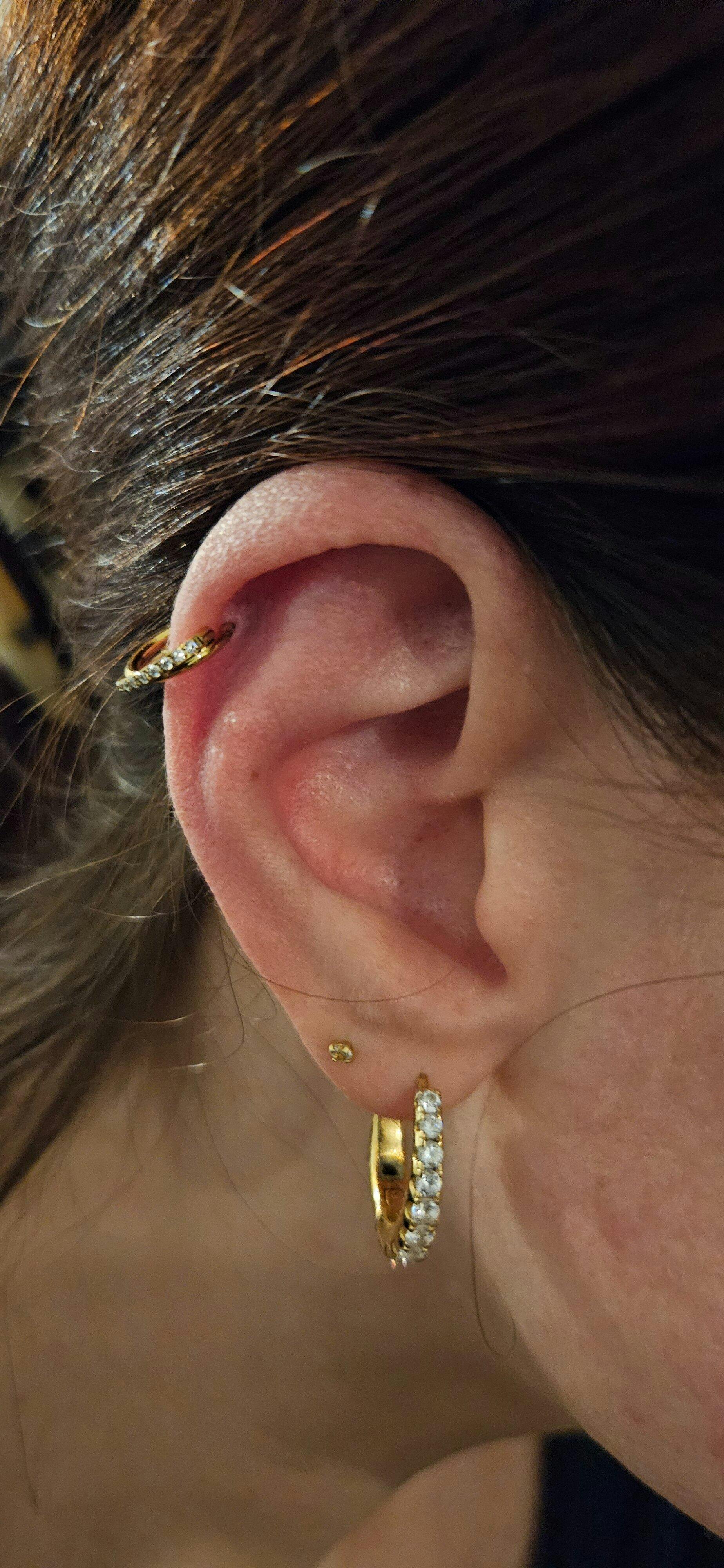
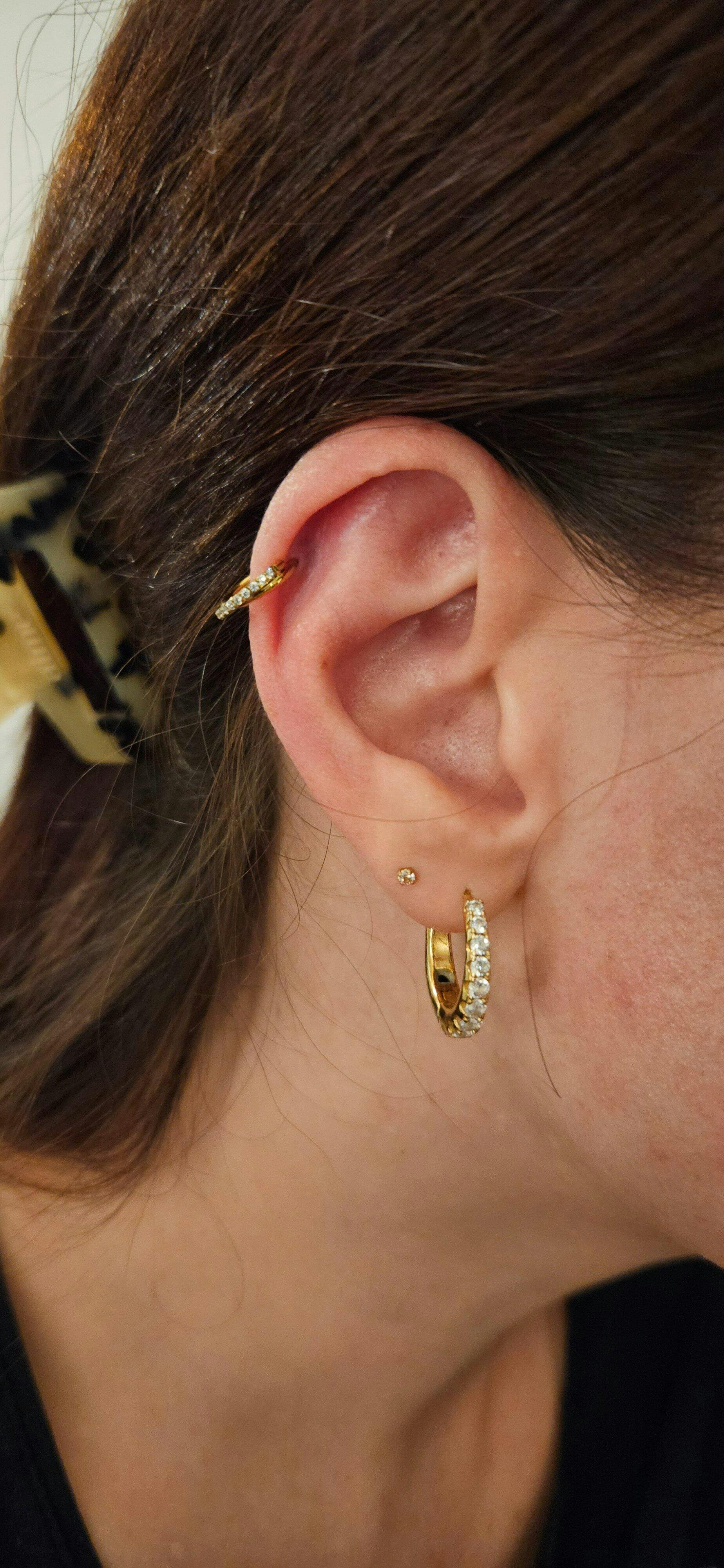
What is a helix piercing?
Okay, first of all, let's start by introducing you to the helix piercing and where it is located on your ear.
As you saw in the image at the beginning of this text, this piercing is located at the very top of the ear cartilage, known as the external ear.
 Image from the website passeportsante.net
There are different variations of this piercing, such as the low helix, the mid-helix, and the forward helix. We'll go into more detail by presenting the different types available today.
 |
Important information:
For initial piercing jewelry, you should never start with a ring. Instead, choose a labret made of ASTM F-136 titanium , 316LVM steel (still very rare, so don't be fooled), 14 or 18 karat gold, or possibly bioplast. The ideal jewelry for optimal healing is a labret with internal screw fastening, mirror polish, ASTM F-136 titanium, and a round, flat base.
|
The different variants
The Double and the Triple
If one piercing is good, two or three are even better! If your morphology allows it (because yes, not everything is necessarily possible on everyone), you can get pierced several times and it will be called a double if you get pierced 2 times, a triple if you get pierced 3 times, etc.
If you happen to decide to get a triple or double helix piercing, make sure there's enough space between the piercings to safely change your jewelry and clean them easily. Of course, this is your piercer's job, and if you choose them carefully, you won't have to worry about these kinds of details. How to choose your piercer .
 Triple piercing for this ear - @piercing_annonay_07 / instagram
The antihelix (Forward helix)
If you follow the curve from the top of your ear until it meets your face, that little hollow in your ear is the anti-helix piercing , also called the forward helix.
As with the helix, you can choose a double or triple piercing. It's usually paired with small, delicate rhinestones on labrets, but you can also style it with rings.
The Mid-Helix
It's not complicated; it's located just below a classic helix and just above the lower helix. If you look at the previous image showing a triple helix, the mid helix would be the lowest of the three.
The lower helix
The lower helix is located just above the earlobe, precisely where the lobe begins and your cartilage ends.
 @Lynnloheide / INSTAGRAM
The Hidden Helix: a discreet and elegant alternative
 Hidden helix by Chloé / Annonay Piercing
For those seeking a subtle yet sophisticated look, the Hidden Helix piercing is an excellent option. Unlike the classic helix piercing, the Hidden Helix is placed slightly further back on the curve of the ear, making it less noticeable at first glance, depending on the jewelry chosen. This strategic placement makes it a preferred choice for those who value discretion or those who must adhere to strict dress codes at work or in other settings.
Despite its discreet appearance, this piercing requires just as much care as a classic helix piercing, especially during the healing period. Furthermore, it's essential to choose suitable jewelry, such as a titanium or gold labret, to ensure optimal comfort and prevent irritation. With a skilled piercer, this style can become a true aesthetic asset while remaining subtle and refined.
This type of piercing perfectly reflects the balance between personal style and practicality, allowing everyone to express themselves while respecting the constraints of daily life.
If the symbolic aspect or meaning of different ear piercings intrigues you, we have also written an article dedicated to the meaning of ear piercings .
|
Quick tip:
We strongly recommend that you do not get both ear cartilage pierced at the same time. Firstly, so you can properly concentrate on the aftercare (especially if it's your first time), and secondly, so you can sleep soundly. Because yes, you'll look pretty silly if you're forced to spend your next few nights like a pharaoh's mummy, completely unmoving while you sleep.
|
 When you try to sleep after getting both ears pierced at the same time.
The cost of this piercing
The price of this piercing can vary depending on the studio you go to, the piercer's experience level, and the type of jewelry you choose. But generally, it will be between 20 and 50 euros.
WARNING! Never go to a piercer who uses a piercing gun for any cartilage piercing. These guns cause trauma to the cartilage that can lead to bumps, keloids, or even lifelong pain. (No thanks!) Furthermore, unlike needles, piercing guns cannot be sterilized, which increases the risk of disease transmission. Just imagine how many times that gun has been used before it's placed on your ear…
Pain and healing time
This is where lobe and cartilage piercings truly differ. Pain is a personal thing, and each person's pain tolerance is 100% subjective. But there is still a difference between the two.
Does a helix piercing hurt?
Like all piercings, it's not painless. That said, many people say it hurts less than other cartilage piercings (like the Daith and Industrial). It's generally described as a pinching or warming sensation rather than actual pain.
On a scale of 1 to 10, let's say it will go from 2 to 4. 10 being absolute hell and 1 is when you're tearing your hair out.
Keep in mind that while the piercing itself may not cause much pain, it may become red and itchy after a few days. Don't worry! This is perfectly normal.
If, however, it still hurts after several months or even a year, there's probably a problem somewhere: the jewelry might be unsuitable, too short, snagged too often, or made of poor-quality material ( we've lost count of the number of piercings we've had to replace because they were bought from a trendy "top designer" all over social media ). First piece of advice if this is the case: go see your piercer. Second piece of advice: choose medical-grade titanium (ASTM F-136). Luckily, that's exactly what we offer.
How long does it take for a helix piercing to heal?
A helix piercing typically heals in 6 months, faster than many other cartilage piercings.
We're talking about six months, provided you don't spend all your time fiddling with it, if the care instructions are followed correctly, and if you haven't bought a supposedly stainless piece of jewelry that's actually the absolute lowest quality. Seriously, stop playing with your health, learn to distinguish between quality and marketing hype , and stop being ripped off.
Aftercare for piercing
Want to give your new piercing the best possible chance of healing quickly? Then read on for the best post-piercing tips!
What is the best way to clean your piercing?
Like all piercings, it's very important to keep your piercing clean so it heals properly. Use a saline solution and a cotton swab to gently clean around your upper cartilage.
When washing your hair, let the warm water run over the piercing for about 15 to 30 seconds to rinse it before drying your piercing with a clean cotton cloth and then cleaning it with a saline solution.
Refrain from touching it until you are certain the piercing is completely healed, and never touch it with dirty hands.
To learn more, take a look at our 10 tips for perfect healing of your piercings .
What should I do if my piercing gets infected?
Unless you spend all your time fiddling with your piercing with dirty hands, if the aftercare was done correctly, a helix piercing isn't particularly at risk of infection. We're starting with this because you often worry a bit too much, and pain in a piercing that's still healing is perfectly normal.
However, if it remains red for several weeks, if you see pus coming out (not to be confused with lymph), or if the pain only increases, go see your piercer as soon as possible. Or your doctor. A piercing infection is very easy to treat, provided you don't let it fester for days. So be vigilant, but don't panic at the first sign of redness.
It is normal to experience mild discomfort, swelling, tenderness, itching, bruising or pain, but these symptoms usually only last a few weeks.
What should I do if my helix doesn't heal?
Consult a professional piercer if your piercing is taking too long to heal, even if you have a high pain tolerance. The jewelry may not be suitable (due to its size, shape, or composition), or you may not be following the aftercare instructions correctly. If the problem stems from the jewelry (which is most often the case), opt for titanium; the difference is truly remarkable. And most importantly, stop trying to wear a ring until your piercing is fully healed.
What jewelry should I choose for a helix piercing?
The great thing about helix piercings is that they are super easy to customize once healed.
During the healing process , we remain calm:
- an ASTM F-136 titanium labret or 14-18k gold,
- Internal screw fastening, flat and round base
- size adapted to your ear (often 1.2 mm x 8 mm, but it depends on your anatomy).
- no ring (we repeat)
Once the helix piercing is fully healed , you can have fun with it:
- Thin rings for a minimalist look.
- Labrets with diamonds, opals or small shapes (stars, moons, flowers),
- Compositions with multiple helixes are possible if your morphology allows it.
If you're looking for ideas, we've prepared a selection of ASTM F-136 titanium helix piercing jewelry right here: Helix Jewelry
When should you change your helix jewelry?
To change your jewelry, the first rule is: wait until the healing process is complete. This means waiting until the upper cartilage of your ear is fully healed before changing your piercing. Generally, it's recommended to leave the initial piercing in for at least three months . This doesn't mean your helix piercing is completely healed, but if done correctly, the healing time won't be affected.
In any case, talk to your piercer before making this decision yourself. Again, especially if it's your first piercing.
We explain how to change your helix piercing .
Where can I find matching jewelry?
I'm glad you asked!
Nåald was founded by two passionate and professional piercing experts. We've created a collection of beautiful rings and labrets , all made of medical-grade titanium, of course. We never compromise on quality, but our prices are designed for people who want to wear beautiful, ornate jewelry without breaking the bank.
What type of jewelry is used for this type of piercing?
Avoid discount sites that use questionable materials, even if they're run by trendy designers popular on social media. Don't compromise on your health. Always choose high-quality jewelry. Solid gold and titanium are excellent options because they're hypoallergenic and promote healing.
Although piercings are traditionally decorated with small rings for cartilage, the style depends on your anatomy and personal taste. Flat-backed and round labrets will also look great on your ear, giving it a fresh new look.
How do I change the helix jewel?
Change is good (as long as your piercing is healed)! This type of piercing is easily replaceable - just make sure it's completely healed before attempting to change the jewelry.
If you're using a labret piercing, simply twist or remove the top to take it off. If you're using a ring, open it by pulling the two ends apart. And there you have it! A whole new look in under a minute!
For more details, we invite you to read our article on how to change your own piercing .
What size should I choose for my piercing jewelry?
When it comes to choosing jewelry, size matters!
Like most cartilage piercings, the helix is usually pierced with 16-gauge needles, which are 1.2 mm thick. Small rings are a popular choice for this location.
8mm (in length) labrets generally fit most ear piercings, but the perfect size will always depend on the curvature of your ear and where the piercing was placed.
If you need it, here is a small size guide for piercings .
Are you hesitating between helix and conch piercings? Check out our guide on conch piercings .
Possible risks and complications (growth, infection)
Even when performed correctly, a helix piercing is still an intervention on the body: it can therefore react. Most of the time, these are minor, benign complications, but they shouldn't be ignored. The idea isn't to scare you, but to help you recognize what's normal… and what warrants a professional opinion.
Small bump, growth or “ball” on the helix piercing
The appearance of a small bump around a helix piercing is quite common. It is often linked to irritation : friction (pillow, helmet, hair), changing the jewelry too soon, unsuitable jewelry, a ring inserted too quickly, or cleaning that is too aggressive or, conversely, insufficient.
In most cases, it is not a “true” keloid , but rather a reactive growth that can be calmed down with the right actions:
- return to an ASTM F-136 titanium labret adapted to your anatomy;
- minimize friction and pressure on the ear ( do not sleep on it );
- resume gentle and regular care (saline solution, no alcohol or harsh disinfectant);
- avoid drilling, puncturing the bump or applying “home remedies” found on social media.
If the bump changes, becomes very painful, starts to ooze, or if its appearance worries you, it is best to consult your piercer and, if necessary, a healthcare professional.
Recognizing an infection in a helix piercing
An infected helix piercing is thankfully rare, especially when aftercare is done properly and the jewelry is of good quality. The signs that should alert you are generally:
- pain that increases instead of subsiding;
- intense redness, marked heat around the piercing;
- significant swelling that does not decrease;
- thick, yellowish or greenish discharge accompanied by an unpleasant odor;
- fever or general feeling of being unwell (in this case, consult a doctor quickly).
If you recognize several of these signs, do not remove your jewelry yourself and do not leave it unattended . An infected piercing requires individual attention: ideally , consult your piercer as soon as possible and, if necessary, see a doctor. Do not apply antibiotics, ointments, or strong disinfectants without medical advice.
How to limit the risk of complications?
To give yourself the best chance of success:
- choose a reputable studio and a quality piece of jewelry made of ASTM F-136 titanium ;
- Follow the care and instructions given by your piercer;
- Avoid shocks, friction, sleeping on it or "playing" with the jewelry;
- Don't change your jewelry too soon, even if the piercing "looks" healed on the surface.
If you have any doubts, persistent discomfort, or an unusual reaction, the simplest solution is to seek professional advice . Good guidance from the first signs often helps prevent minor irritations from developing into a real problem.